
Non-relativistic quantum description of particles with spin
The operator associated with the spin of a particle is a vector observable. Its components satisfy the commutation relations that define an angular momentum operator. The quantum state of a particle with spin is not completely specified by specifying its wave function ψ(r) in orbital space Er. We must also specify its spin variables in spin space Es. A given particle is characterizes by a unique value of s, which is a positive integer or half integer. (2s + 1) basis vectors span the spin space Es of this particle. We can choose these basis vectors to be {|s,ms>, ms= -s, -s+1, ..., s}, the eigenvectors of S2 and Sz. The state space of the particle is the tensor product space E = Er ⊗ Es. The spin observables commute with all the orbital observables.
For the electron Es is two-dimensional. The observables {X,Y,Z,S2,Sz} form a C.S.C.O.
in E = Er ⊗ Es.
So do the observables {Px,Py,Pz,S2,Sz}.
Since {|r>} forms a basis for Er and {|ε>,|ε> = |+>,|->} forms a basis for Es, {|r>
⊗ |ε> = |r,ε>}
forms a basis for E for a spin ½ particle.
Each vector |r,ε>
is a common eigenvector of X, Y, Z, S2, and Sz.
We
have
X|r,ε> = x|r,ε>, Y|r,ε> = y|r,ε>, Z|r,ε> = z|r,ε>,
S2|r,ε> = (3/4)ħ2|r,ε>, Sz|r,ε> =
εħ|r,ε>.
<r',ε'|r,ε> = δεε'δ(r - r'),
(normalization) Σε∫d3r|r,ε><r,ε| =
I, (completeness).
For any vector |ψ> we have |ψ> = Σε∫d3r|r,ε><r,ε|ψ>
= Σε∫d3r ψ(r)|r,ε>, with ψ(r) = <r,ε|ψ>.
Notation:
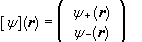
Let ψ+(r) = <r,+|ψ>, ψ-(r) = <r,-|ψ>, and let
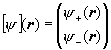
be a two component spinor, with its adjoint [ψ]†
= (ψ+*(r), ψ-*(r)).
For a spin ½ particle |ψ> is
completely specified by the two component spinor, just as for a spinless particle |ψ> is specified by the
wave function ψ(r). The inner product is defined through
<ψ|Φ> = Σε∫d3r|<ψ|r,ε><r,ε|Φ> = ∫d3r(ψ+*(r)Φ+(r)
+ ψ-*(r)Φ-(r)) = ∫d3r[ψ]†[Φ].
Note: Matrix multiplication of the spinors precedes the spatial integration.
The state is normalized in the following way:
<ψ|ψ> = ∫d3r(ψ+*(r)ψ+(r) + ψ-*(r)ψ-(r))
= 1.
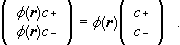
The spinor associated with a tensor product vector |ψ> = |Φ> x |Χ>
with |Φ> = ∫d3r Φ(r)|r> in Er
and |Χ> = c+|+> + c-|-> in Es
is
Note: Not all vectors in E are tensor product vectors.
Let |ψ> be the state of a spin ½ particle and let
|ψ’> be obtained from |ψ>
through the action of a linear operator A, A|ψ> = |ψ’>.
We can associate with each linear operator A
a 2 x 2 matrix [A] such that [A][ψ](r) = [ψ’](r).
 ,
,

 .
.
 .
.
The matrix of a spin operator is its matrix in the { |+>, |-> } basis in Es.
Similarly, if A = Sz then
 .
.
We have
 ,
,
 .
.
The matrix of an orbital operator is diagonal.

 .
.
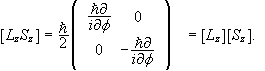
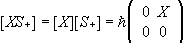
Similarly, if A = XS+ , then
 .
.
Rotation operators for a spin ½ particle
Consider a system consisting of a single spin ½ particle. Neglect the spatial degrees
of freedom. Rotate the system ccw about the z-axis through an angle φ. If the state of the system is |α>
before the rotation, it is |α>R after the
rotation, where |α>R = U(R)|α>, U(R) =
exp(-iSzφ/ħ) = exp(-iσzφ/2).
Before the rotation the expectation value of the operator Sx is <Sx> = <α|Sx|α>, after the
rotation it is <Sx>R = R<α|Sx|α>R. We may expand

since σz2 = I. The expression for U†(R)SxU(R) therefore may be written

In matrix notation we have


 .
.
Therefore R<α|Sx|α>R = <α|U†(R)SxU(R)|α>
= <α|Sxcosφ - Sysinφ|α>
= <Sx>cosφ - <Sy>sinφ.
Similarly R<α|Sy|α>R = <Sy>cosφ
+ <Sx>sinφ.
The average value of Sz does not change, since it commutes with U(R).
The expectation value of the spin operator S behaves as though it were a
classical vector under rotation.
We have <Si>R = ∑iRij<Sj>,
where R is the 3 x 3 rotation matrix for the rotation
being considered. For an arbitrary system we can generalize to
<Ji>R = ∑iRij<Jj>.
[Remember S is a vector operator.
While the
expectation values of the components of S behave as the
components of a classical vector under rotation, the components of S
itself behave like a classical vector rotated backward, S' = R-1S.]
How does the state vector of the spin ½ particle behave under rotation?
Let |α> = c1|+> + c2|->.
|α>R = U(R)|α> = exp(-iSzφ/ħ)|α> =
exp(-iφ/2)c1|+> + exp(iφ/2)c2|->.
For φ = 2π we have |α>R = -c1|+> - c2|-> = -|α>.
A 360o rotation does not give us the original ket back. We need to rotate
through 720o to get back our original state vector. This is a classically
totally unexpected result.
Can it be observed?
The minus sign is a change in the phase of the state vector. If all state vectors are
multiplied by a minus sign there will be no observable effect. We can only observe changes
in relative phase. We must compare a rotated ket to an unrotated ket and look for
interference effects. Assume a spin ½ particle can move from point A to point B along two
different path. Assume that when we observe the particle at point B we do not know which
path it actually took to get there. Assume that path 1 does not rotate the state vector
and path 2 does rotate the state vector.
Let {|ψ(1)>,|ψ(2)>}
be the eigenstates of the observable that determines the path of the particle. Assume that at point A the state vector is
|α(0)> = 2(-1/2)(|ψ(1)> + |ψ(2)>).
At point B the state vector is
|α(t)> = 2(-1/2)U(t,t0)(|ψ(1)> + |ψ(2)>).
Assume the evolution operator rotates |ψ(2)> but
not |ψ(1)>. If |ψ(2)>
is rotated through 360o then the state vector at point B is
|α(t)> = 2(-1/2)(|ψ(1)> - |ψ(2)>).
The probability of finding the particle at point B is
|<rB|α(t)>|2 = ½|<rB|ψ(1)> - <rB|ψ(2)>|2.
If without rotation the probability of finding the particle at point B is
1, then with rotation we have destructive interference.
How can we rotate the state vector?
The Hamiltonian of a spin ½ particle in a magnetic field B = Bk is H =
ωSz where ω = -γB is proportional to the magnetic field strength.
The evolution
operator therefore is U(t,0) = exp(-iωSzt/ħ).
The evolution operator equals the rotation operator with φ = ωt.
This explains spin precession. In a magnetic field B = Bk we have
<Sx>t = <Sx>t=0cos(ωt) - <Sy>t=0sin(ωt),
<Sy>t = <Sy>t=0cos(ωt) + <Sx>t=0sin(ωt),
<Sz>t = <Sz>t=0.
Assume that in a neutron interferometry experiment path 1 goes through a field free
region and path 2 goes through a region with a static magnetic field
B = Bk.
Then |α(t)> = 2(-1/2)(|ψ(1)> + exp(-i(ωT/2)|ψ(2)>).
The intensity at
point B is therefore is proportional to C + Dcos(ωT/2).
We can vary the angle φ = ωT
by varying the magnetic field strength. The intensity at point B is predicted to vary
sinusoidally with a period 4π/ω. These
predictions have been experimentally verified.
 .
.
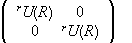
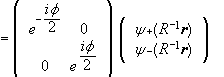
After the rotation the state vector is |ψ>R = U(R)|ψ>, where U(R) = rU(R)
⊗ sU(R). U(R) is a mixed operator.
The matrix for rU(R) is
 and the matrix for sU(R) is
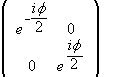 .
.
We therefore have

 .
.
How can we characterize a rotation? We need three real numbers to characterize a general rotation. We can, for example, specify the direction of the rotation axis (two angles) and the rotation angle. We can also specify the 3 x 3 rotation matrix R. R has 9 elements. R is an orthogonal matrix. RRt = RtR = I. The orthogonality condition results in a set of 6 independent equations for 9 unknowns. Therefore R contains 3 independent numbers.
The set of all multiplication operation with orthogonal matrices forms a group. This group has the name SO(3). (S stands for special (determinant = 1), O stands for orthogonal, 3 stands for three dimensions.)
We can also characterize a rotation by specifying the 2 x 2 unitary matrix U(R) which is the matrix representations of the rotation operator in Es. The most general form of such a rotation matrix is


with |a|2 + |b|2 = 1 and a and b complex numbers. Again we have 3 independent elements. The matrices U(R) also form a group. This group has the name SU(2). (S stands for special, U stands for unitary, 2 stands for dimensionality 2.) The groups SO(3) and SU(2) are not isomorphic. A 2π rotation and a 4π rotation are represented by the same R matrix but by different U(R) matrices. U(a,b) and U(-a,-b) correspond to the same 3 x 3 rotation matrix in the SO(3) language. For a given R the corresponding U(R) is double valued.