More Problems
Problem 1:
 A puck of mass 80 g and radius 4 cm slides along an air table at a speed of
1.5 m/s. It makes a glancing collision with a second puck of radius 6 cm
and mass 120 g (initially at rest) such that their rims just touch. The
pucks stick together and spin after the collision.
A puck of mass 80 g and radius 4 cm slides along an air table at a speed of
1.5 m/s. It makes a glancing collision with a second puck of radius 6 cm
and mass 120 g (initially at rest) such that their rims just touch. The
pucks stick together and spin after the collision.
(a) What is the angular momentum of the system relative to the center of
mass?
(b) What is the angular velocity about the center of mass after the
collision?
Solution:
- Concepts:
Momentum and angular momentum conservation - Reasoning:
The system consists of the two pucks. No external forces and torques act on the system, so the total momentum and angular momentum of the system are conserved. - Details of the calculation:
Let the center of the 120 g mass be at the origin before the collision.
(a) Before the collision, the y-coordinate of the CM is
(m1y1 + m2y2)/M = (0.08*0.1/0.2) m = 0.04 m.
The x-coordinate of the CM is (m1x1 + m2x2)/M = (0.08/0.2)x1 = (0.4)x1.
The velocity of the CM is
vCM = dxCM/dt = (0.4) dx1/dt = (0.4)1.5 m/s = 0.6 m/s in the x-direction.
In the lab frame the m1 moves with velocity v = 1.5 m/s i
and the CM moves with vCM = 0.6 m/s i.
With respect to the CM m1 moves with velocity v1 = v - vCM = 0.9 i m/s ,
and m2 moves with velocity v2 = 0 - vCM = -0.6 i m/s.
The angular momentum of the system about the CM is
L = -(m1v1(y1 - yCM) + m2v2yCM ) k = -(7.2*10-3 kg m2/s) k.
(b) In the collision momentum and angular momentum are conserved.
The total angular momentum about the CM after the collision is Iω = -(7.2*10-3 kg m2/s )k.
The moment of inertia of the system about the CM is I = I1 + I2, where I1 = ICM1 + M1R12, and I2 = ICM2 + M2R22.
I1 = (1/2) 0.08 kg(0.04 m)2 + 0.08 kg(0.06 m)2 = 3.52*10-4 kg m2.
I2 = (1/2) 0.12 kg(0.06 m)2 + 0.12 kg(0.04 m)2 = 4.08*10-4 kg m2.
I = I1 + I2 = 7.6*10-4kg m2.
ω = L/I = -(9.47/s) k.
To find the moment of inertia of the composite object after the collision the parallel axis theorem was used.
Problem 2:
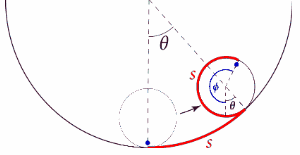
A hoop of radius r can roll inside a fixed circular track of radius R, as shown in the figure. If the hoop starts at θ = 90o from rest, what is its angular speed dφ/dt at θ = 45o?
Solution:
- Concepts:
Energy conservation - Reasoning:
Rolling involves only static friction and gravity is a conservative force. - Details of the calculation:
The angles θ and φ are connected through the equation of constraint Rθ = rφ + rθ.
(R - r)θ = rφ.
E = T + U = 0. We set the zero of the potential energy at θ = 90o.
½m(R - r)2(dθ/dt)2 + ½mr2(dφ/dt)2 - mg(R - r)cosθ = 0.
(dθ/dt)2 = gcosθ/(R - r).
(dφ/dt)2 = g(R - r)cosθ/r2 = g(R - r)/(√2r2).
The angular velocity of the hoop at θ = 45o is dφ/dt = (g(R - r)/(√2r2))½.
Problem 3:
(a) Show that the angular deviation ε of a plumb line (a simple pendulum at
rest) from the true vertical at a
point on the
earth's surface at a northern latitude λ is
ε = (R Ω2 sinλ cosλ)/(g - R Ω2 cos2λ).
(R = radius of the earth = 6.36*106 m. Ω = angular speed =
7.3*10-5/s. At λ = 45o, ε = 1.73*10-3 rad ~ 0.1
deg.)
(b) An object is dropped from a height h above the earth's surface at
latitude λ. Find the magnitude and direction of its deflection from the
plumb line position when it hits the ground in terms of h and geff. Here geff is the acceleration due to gravity already corrected for the
centrifugal force, geff = g + O(Ω2). Neglect
terms of order Ω2 and air resistance, and consider only small vertical heights.
Solution:
- Concepts:
Motion in an accelerating frame - Reasoning:
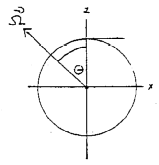
Assume an observer in the rotating frame at mid latitudes λ = 90o - θ.
The equations of motion in a rotating coordinate system contain fictitious forces.
mdv/dt = Finertial - mΩ × (Ω × r) - 2mΩ × v. - Details of the calculation:
The pendulum bob is at rest. The net force on the bob is zero.
Finertial - mΩ × (Ω × r) = 0.
Finertial = -mg k + T. (T is the tension.)
Ω × r = ΩRsinθ j.
Ω × (Ω × r) = ΩRsinθ (Ω × j) = ΩRsinθ (Ωx k - Ωz i)
= -ΩRsinθ (Ω sinθ k + Ω cosθ i).
-mg k + mΩ2R sin2θ k + Tz k - mΩ2Rsinθ cosθ i + Tx i = 0.
Tz = mg - mΩ2R sin2θ, Tx = -mΩ2Rsinθcosθ.
tan(ε) = ε = -Tx/Tz = (Ω2Rsinθcosθ)/(g - Ω2R sin2θ).
ε = (R ω2 sinλ cosλ)/(g - R ω2 cos2λ).
(b) mdv/dt = mgeff - 2mΩ × v.
dvz/dt = -geff , dvy/dt = 2Ωxvz.
(Ω × vy j is of order Ω2 and we neglect it, vy << vz.)
vz(t) = -gefft, vy(t) = -2Ωxgeff∫0tt'dt' = -Ωxgefft2 = Ω sinθgefft2.
y(t) = ∫0tvy(t')dt' = Ω sinθgefft3/3.
h = ½geff t2, t = (2h/geff)½.
deflection: y(h) = (1/3)Ω sinθ(2h3/geff)½, or
y(h) = (1/3)Ω cosλ(2h3/geff)½,
The object is deflected eastward.