Review
Problem 1:
 In the circuit shown the voltage varies sinusoidally, with V0 = 9 V and ω =
440/s.
In the circuit shown the voltage varies sinusoidally, with V0 = 9 V and ω =
440/s.
(a) Calculate the peak value of the current I.
(b) Calculate the phase of I relative to the applied voltage and state whether I(t) leads or trails V(t).
Solution:
- Concepts:
AC circuits - Reasoning:
We are asked to analyze an AC circuit. - Details of the calculation:
(a) V = IZ. Let V = V0exp(i(ωt + φV)).
Z = R + iωL + 1/(iωC) = [40 + i*(440*0.5) - i/(440*10-5)] Ω
= [40 - i7.27] Ω = 40.66 exp(iφ) Ω with tanφ = -0.18, φ = -0.178.
I = V/Z = (9 V)exp(i(ωt + φV))/(40.66 exp(-i0.18)) Ω
= 0.22 A exp(i(ωt + φV + 0.178)) = I0exp(i(ωt + φI))
The peak value of the current is 0.22 A.
(b) φI - φV = 0.178. I(t) leads V(t).
Problem 2:
The operators a and a† when acting on the energy eigenstates of
the harmonic oscillator, denoted by |n>, have the property
a†|n> = (n + 1)½|n + 1>, a|n> = n½|n - 1>.
We have x = (a + a†)/(2α), p = -i(a - a†)/(2β), where α
=√(mω/(2ħ)), β =1/√(2mωħ).
Find the mean value and root mean square deviation of p2, when the
oscillator is in the energy eigenstate |n>.
Solution:
- Concepts:
Fundamental assumptions of QM, the eigenstates of the harmonic oscillator Hamiltonian, the raising and lowering operators - Reasoning:
For any operator A we have ∆A = (<(A - <A>)2>)½ = (<A2> - <A>2)½. - Details of the calculation:
p2 = -(mħω/2)(a†a† - a†a - aa† + aa).
<p2> = -(mħω/2)<n|(a†a† - a†a - aa† + aa)|n> = (mħω/2)(2n + 1).
The mean value is <p2> = (mħω/2)(2n + 1).
p4 = (mħω/2)2(a†a† - a†a - aa† + aa) (a†a† - a†a - aa† + aa).
<p4> = (mħω/2)2<n|(a†a† aa + a†a a†a + a†a aa† + aa† a†a + aa† aa† + aaa†a†)|n>
= (mħω/2)2(6n2 + 6n + 3).
<p4> - <p2>2 = (mħω/2)2(2n2 + 2n + 2).
∆p2 = (mħω/2)( 2n2 + 2n + 2)½ is root mean square deviation of p2.
Problem 3:
A capacitor composed of two parallel infinite conducting sheets separated by a distance d is connected to a battery. The lower plate is maintained at some potential V1 and the upper plate is maintained at some potential V. A small hemispherical boss of radius a << d is introduced on the lower plate. State the boundary conditions for this problem. (Hint: Consider the limit as the distance between the plates becomes very large.) Find the potential between the plates and the surface charge density on the plates.
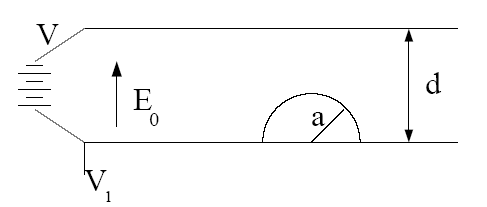
Solution:
- Concepts:
Boundary value problems, azimuthal symmetry. - Reasoning:
Put the origin of the coordinate system at the center of a sphere, the upper half of which is the hemispherical boss. Let the z-axis point up.
Then Φ(r,θ) = ∑n=0∞[Anrn + Bn/rn+1]Pn(cosθ) is the most general solution in the region between the plates, since the charge density ρ = 0 there. To find the specific solution we apply boundary conditions. - Details of the calculation:
The boundary conditions are Φ = V1 on the lower plate and the boss and Φ = V on the upper plate.
Φ = V1 + A1'rcosθ + (B1'/r2)cosθ between the plates outside the boss.
We assume all other coefficients are zero. If we find a solution with this assumption, it is the only solution.
Boundary conditions:
(i) Φ is continuous at r = a. 0 = A1'a + B1'/a2. B1' = -A1'a3.
(ii) E = -∇Φ = E0 at r >> a, i.e. far away from the hemispherical boss.
-A1'cosθ = E0cosθ, A1'sinθ = -E0sinθ, A1' = -E0, B1' = E0a3. E0 = (V - V1)/d.
Therefore
Φ = V1 - E0rcosθ + (E0a3/r2)cosθ.
Er = E0cosθ + 2(E0a3/r3)cosθ, Eθ = -E0sinθ + (E0a3/r3)sinθ.
E = E0 + 2(E0a3/r3)cosθ (r/r) + (E0a3/r3)sinθ (θ/θ).
E = external field + field due to polarized sphere.
Surface charge on the plates: σ = ε0E·n.
E·n = -E0 on the upper plate, σ = -ε0E0.
E·n = -Eθ = E0 - (E0a3/r3) on the flat part of the lower plate, σ = ε0E0 - ε0(E0a3/r3).
E·n = Er = 3E0cosθ on the boss, σ = ε03E0cosθ.
Problem 4:
Through some coincidence, the Balmer lines from singly ionized helium in a distant star happen to overlap with the Balmer lines from hydrogen in the sun. Assuming that the relative motion is along the line of sight, how fast is that star receding from us?
Solution:
- Concepts:
Doppler shift, hydrogenic atoms - Reasoning:
f' = f [(c - v)/(c + v)]½. - Details of the calculation:
Balmer lines from H: hfH = 13.6 eV(1/4 - 1/ni2).
Balmer lines from He+: hfHe+ = 4*13.6 eV(1/4 - 1/ni2).
fH = fHe+ [(c - v)/(c + v)]½.
1/4 = [(c - v)/(c + v)]½.
v = c(1 - 1/16)/(1 + 1/16) = 2.65*108 m/s.
Problem 5:
Consider a quantum description of a non-relativistic 2D electron gas confined to the x−y plane of a Cartesian coordinate system, with a magnetic field B pointed in the z direction. The effect of electronic coupling to the field may be included by modifying the momentum operator p = (px, py) in the Hamiltonian to include a term depending on the vector potential A associated with the magnetic field:
H = (1/(2m)) ((ħ/i)∇ - qeA(r,t))2,
where qe is the
electron charge. Show that the different (gauge) choices for the vector
potential
A
= (0, Bx, 0) (Landau gauge),
and
A = ½B(-y, x, 0) (symmetric gauge),
both give the required
magnetic field.
Solution:
- Concepts:
∇∙B = 0 --> B = ∇×A. - Reasoning:
A is not unique. A' = A + ∇ψ + C, with ψ an arbitrary scalar field and C an arbitrary constant vector is also a vector potential for the same field. - Details of the calculation:
∇×A = (∂Az/∂y - ∂Ay/∂z, ∂Ax/∂z - ∂Az/∂x, ∂Ay/∂x - ∂Ax/∂y).
∇×A1 = (∂Ay/∂x)k = Bk = B.
∇×A2 = ∂Ay/∂x - ∂Ax/∂y) k + (½B + ½B) k = Bk = B.
Both vector potentials are associated with the same magnetic field B.
Problem 6:
Centered at the origin of coordinates is an insulated, conducting sphere of radius a. A positive point charge q is located a distance d (d > a) from the center. What is the smallest positive charge, which must be on the sphere in order that the surface charge density will nowhere be negative?
Solution:
- Concepts:
The method of images - Reasoning:
The method of images is the preferred method for finding the potential of a charge distribution outside a conducting sphere. - Details of the calculation:
Assume that the point charge q is located on the z axis at z = d. Place an image charge q' = -aq/d on the z-axis at z' = a2/d. This will keep the sphere at zero potential. Assume the sphere must hold a total charge Q = q' + q'' in order that the surface charge density will nowhere be negative. Place q'' at the center of the sphere.
σ = ε0Er is the surface charge density.
Er is the radial component of the electric field on the surface.
Er(ar/r) = [1/(4πε0)][q(ar/r - dk)∙(r/r)/|ar/r - dk|3
- (aq/d)(ar/r - (a2/d)k)∙(r/r)/|ar/r - (a2/d)k|3 + (q''/a2)]
= [1/(4πε0)][q(a - dcosθ)/(a2 + d2 - 2adcosθ)3/2
- (aq/d)(a - a2cosθ/d)/(a2 + a2/d2 - 2a3cosθ/d)3/2 + (q''/a2)]
= [1/(4πε0)][q(a - dcosθ - d2/a + dcosθ)/(a2 + d2 - 2dacosθ)3/2 + (q''/a2)]
= [q/(4πε0a2)][(1 - d2/a2)/(1 + d2/a2 - 2(d/a)cosθ)3/2 + (q''/q)].
σ = ε0Er = [q/(4πa2)][(1 - d2/a2)/(1 + d2/a2 - 2(d/a)cosθ)3/2 + (q''/q)].
(1 - d2/a2)/(1 + d2/a2 - 2(d/a)cosθ)3/2 is a negative number. Its magnitude is largest when the denominator is smallest.
σmin = ε0Er = [q/(4πa2)][(1 - d2/a2)/(1 + d2/a2 - 2(d/a))3/2 + (q''/q)].
We want σmin = 0.
q'' = q(d2/a2 - 1)/(d/a - 1)3 = q(d/a + 1)/(d/a - 1)2.
The smallest positive charge, which must be on the sphere in order that the surface charge density will nowhere be negative is
Q = q'' + q' = q'' - (aq/d) = q[(d/a + 1)/(d/a - 1)2 - a/d].
A simpler way of finding q'':
σ = ε0Er is the surface charge density. It will have its lowest value at z = a, because q' is closest to that surface point.
Er(z = a) = E(z = a) = [1/(4πε0)][-q/(d - a)2 - (aq/d)/(a - a2/d)2 + q''/a2].
σ(z = a) = [q/(4πa2)][-1/(d/a - 1)2 - (d/a) /(d/a - 1)2 + q''/a2]
= [q/(4πa2)][-(d/a + 1)/(d/a - 1)2 + q''].
σ(z = a) is negative unless q'' ≥ (d/a + 1)/(d/a - 1)2.
For σmin = 0 we need q'' = (d/a + 1)/(d/a - 1)2.